
In our modern world, we lost ourselves in the rhetoric of believing in better future. Getting up everyday like it’s a Monday morning and dragging ourselves to work for various reasons like to have a better future, to give our spouses a good life, to give our children a good life, to have a good post retirement life, to have a good status, etc, we are investing our present for our better future and this better future entirely scales to the amount of money you are having. The currency on which we are betting so much on was not the same as it once was, at least not until 1971.
What is a currency?
Currency refers to any particular money (physical or virtual or commodity based or by any other means) which is in circulation among general public and accepted by designated government body of that particular state.

Source: Google.
History of Modern currency.
“The farther back you can look, the farther forward you are likely to see.”
Winston Churchill
To understand the modern currency we need to look back into our previous monetary systems. In currency’s history, most of its pages are filled either with gold or with silver. People used to trade commodities for gold or silver coins and these precious metals are heavy and also started attracting danger to merchants. To make this more safer and easier banks came into play, where you can deposit your money and get a certificate of deposit and exchange it in the branch nearer to your place for your precious metals.
Around mid 19th century, countries started to develop certificates or currencies equivalent to a specific amount of gold, this is the classical gold standard.In United states, a $20 bill gives you and equivalent of $20 gold. That is, if you go to a bank and ask for gold or silver for your 20 dollar bill, the bank will give you gold or silver.

During World war 2, the whole of Europe is in War frenzy. Most of there man power and industries are used to support war. This lead to the decrease in food production in Europe. So, European countries started importing food produced from various parts of the world like America, India, etc. America started to receive gold as payment and its gold reserves amounted to almost two thirds of World’s monetary gold. It’s economy doubled in the first four years of World war – 2 from $71 billions to $142 billions.
During 1 – 22 of July 1944 a conference was held in Bretton-woods, New Hampshire. Delegates from 44 countries had attended the conference and signed the famous Bretton – woods agreement which is a first of its kind to fix exchange rates among independent states. All parties agreed to adopt a monetary policy that maintained their external exchange rates within 1 percent by tying its currency to gold and the ability of the IMF to bridge temporary imbalances of payments. That’s when IMF and World Bank are formed. At this point gold is pegged at $35 per ounce.

After this, America started to finance in rebuilding of Europe by buying foreign bonds in exchange for dollars.When US fell short of dollars, it started to print dollars more than the gold reserves it has (as no reserve ratio is mentioned in Bretton – woods agreement) and these dollars were used in investing in Europe.For some reasons, the gold rates were never revalued to the amount of dollars printed.
Everything was going fine, until in 1960’s president of France understood the situation and started to exchange dollars for money. Many other countries Joined France and started asking gold for dollars. This lead to the depletion of gold reserves in US. If US gold reserves reaches zero the US dollar bills don’t have any backing and the entire world’s monetary system will crumble. For this reason, President Nixon brought a temporary halt , later permanent, to exchange of gold to dollar bills.
On August 15th of 1971, all the currencies became Fiat currencies.Fiat comes from the Latin word ‘let it be so’. These currencies are not backed by any commodity, instead it is backed by the government that issue it and this is our present day currency. As these Fiat currencies are not backed by any commodity it’s a good news for government. The government can print these currencies and fund it’s wars, debts, investments in infrastructure and etc, but, printing these currencies more will lead to more amount of currency circulating in the market and this will lead to an increase in price of goods. This phenomenon is also known as inflation.
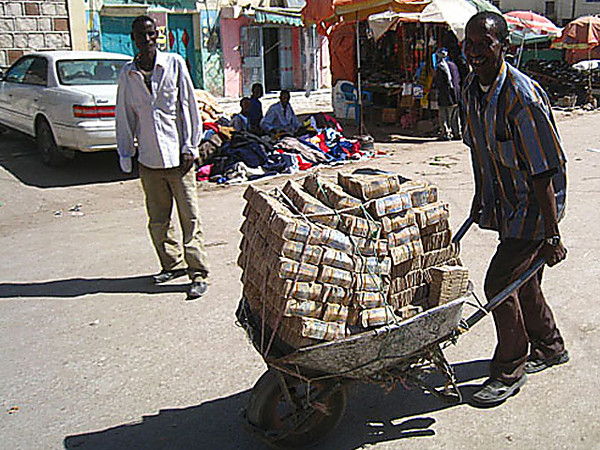
Let’s suppose, our Indian government has bought all the black money back to India and distributed 15 Lakh rupees to all the citizens. Now everyone in our country is richer by 15 Lakh rupees and government can reduce its subsidy or increase tax on fuel prices because we can afford it. Because of this move, transportation costs of commodities will increase and which leads to indirect price appreciation of other commodities. There by making everything costly and this is inflation.In a very bad situation it may turn into Hyperinflation like in Zimbabwe or Somalia where if you want to buy milk you need to carry a hoard of money .

What makes our currency float?
After Britton woods agreement, the monetary system changed to partial Gold standard exchange system. Where exchange rates of currencies were fixed, but the modern fiat currencies don’t have a fixed exchange rate they change everyday. But what makes our currency rate change everyday? If we need to know the reason behind this we need to look closely at basics of economics. Price of a good depends upon its demand.If the demand of that good increases the price of the good decreases and if the demand of that good decreases the price of the decreases.This above principle applies to Fiat currencies.
At present there are three types of methods to fix currency exchange rates.
- Floating Exchange rate system: A free Floating exchange rate currency has its rate set by Foreign exchange market depending upon the demand and supply for that currency relative to other currencies. This demand and supply is produced through various sources like trade, FDI, speculation, political situations, etc. For suppose, US imports $100 worth of goods from India, for which it has to sell its dollars and buy $100 worth of rupees (on that day’s exchange rate) to pay to Indian suppliers. This increases the demand for rupee and decreases the demand for dollars. As a result Rupee appreciates against dollar. Currencies like British pound, American Dollar, New Zealand dollar have this sytem
- Fixed exchange rate system: In this system, the currency of one country is pegged to another currency or commodity or bunch of other currencies. This type of exchange rate system is good for smaller economies as they take debt from stable or developed foreign countries , to which they peg their currency, and repayment amount will be as anticipated. The main disadvantage of this type of system is it’s currency will depend entirely on the currency value to which its pegged. Currencies like UAE Dirham, Honkong dollar, Nepalese rupee. etc have this type of system
- Managed Floating Exchange rate system: The exchange rates are generally allowed to float but when there is a heavy volatility in the market, the central bank or government of that particular currency intervenes in the foreign exchange market and tries to stabilize the rate i.e., if the rupee is going down, the RBI sells its foreign reserves and buy back rupee their by increasing rupee value or if rupee value is appreciating too high, RBI buys dollars by selling rupee and this brings down the value of rupee. Countries like China, India, Japan, Brazil,etc,. follow this system.

Factors which effects exchange rates
Though the title looks like there are different type of factors, they all are actually pegged to Demand and supply rule of currency
Trade
Trade is the primary factor that effects countries exchange rate. Let’s assume India supplied Milk to America, for which American importer has to sell US dollars and buy Indian dollars to pay to their Indian supplier.Here, demand for Rupee has increased so Rupee’s value gets appreciated and If India imports Aeroplanes from US we sell rupees and buy dollars, their by increasing dollar value. The trade balance between these two exchanges determines the demand of the currency and the currency with more demands experiences a appreciation.
Interest Rates
Foreign Investors tend to invest in countries with Higher interest rates, because they receive higher interest amount for their investment. If a country X cuts its interest rates than the general market value, investors remove their investments in that country and invest in some other country whose interest rates or more. In this transaction, investors sells currency of country X and buy the currency of some other country whose interest rates are high, there by loosing demand for currency of Country X and depreciating the value of their currency. If the rates are hiked, the opposite happens. Countries try to cut interest rates to encourage loans and circulate more money into the countries market there by producing more jobs. This might increase the inflation value(which is kept in between 2% -6%) but the Regulatory Bank will try to control it. If the inflation is too high i.e., the prices of commodities are increasing, then Central bank hikes its interest rates their by reducing the flow of money in market and bringing down the costs.
Controlled depreciation
Many countries try to keep their currency exchange rate as low as possible manually. China buys a lot Dollars and increases its foreign exchange reserves and indirectly creates demand for dollars and decreases demand for yuan. But this sounds weird, why does a country artificially decreases its currency value? To know this let’s go through a small example: India and China are both exporting computers of same quality and price. The cost of one computer in India is Rs.15,000/- and in China it is 15,000 yuan. Let the exchange rates be 1 USD = RS. 50 and 1 USD = 50 yuan. The american customer pays $ 300 for 1 computer and buys 3 for $ 900 . Let’s say China weakened yuan value to double,i.e., 1 USD = 100 yuan, then the same american can buy 6 computers. So, customers will start to buy from China because it gives more goods to same amount of dollars. The exports in China will boom and creates a good economy. This increase in Exports will create demand for Chinese Yuan,there by appreciating Chinese yuan again. So, Chinese central bank buys more dollars to halt the appreciation of Chinese yuan
Political situation
If a country is in war, this will be a bad sign for investors, because, in general, wars bring havoc to the economy of a country. If investors are leaving the market they sell the currency and bring down the demand for it. It’s just not only war but also political turmoil, assassination of state heads, ratings by rating agencies like S&P, etc.
Oil Prices
India is the third largest importer of oil. To purchase oil we pay in dollars and OPEC countries accept dollars as a payment. So we sell our rupees and buy dollars and pay in dollars. If this goes on demand for dollars increase and demand for rupees decrease there by decreasing the value of our currency. If the production of oil is hiked and supply is more, then the price of oil comes down and the demand for no of dollars to be spend per barrel decreases there by depreciating US dollar.
Speculation
If the markets speculate that demand for Indian rupee increases in future, they will start buying more rupees to make a profit in future. This will create demand for rupee and rupee value appreciates and the vice-versa will depreciates rupee value.
Relative strength of other currency
The exchange rates are generally compared against dollar. If the demand for dollar in other markets of the world has fallen then the value of dollar depreciates there by appreciating rupee value, though there is no increase in demand for rupee and the vice-versa creates depreciation of rupee.
Government Debt
If the amount of government debt increases, then it may raise fear in market about the ability of government to repay the debt. If the economic growth is good then Foreign investors may remain in the market but if they fear that a government can not repay they move out of that countries markets and bring down the currency value.
These are all just few factors and there are many more which effects the exchange rates of a currency.
Many economists believe that our modern monetary system will be replaced by some other monetary system in future, as this has replaced previous monetary systems which has replaced their own predecessors. Who knows we might revert back to gold or silver.
Note:- For readers, who are interested in Forex as an investment destination remember the above factors and do your research before investing in a currency. Foreign exchange works in lots of standard ( 1,00,000 units), Mini (10,000 units), Micro (1,000 units), Nano (100 units) .Foreign exchange markets will be open 24 hours a day except in weekends i.e., 22:00 GMT on Sunday (Sydney) to 22:00 GMT on Friday (New York).
Happy Reading…:-)
 What's going on!!